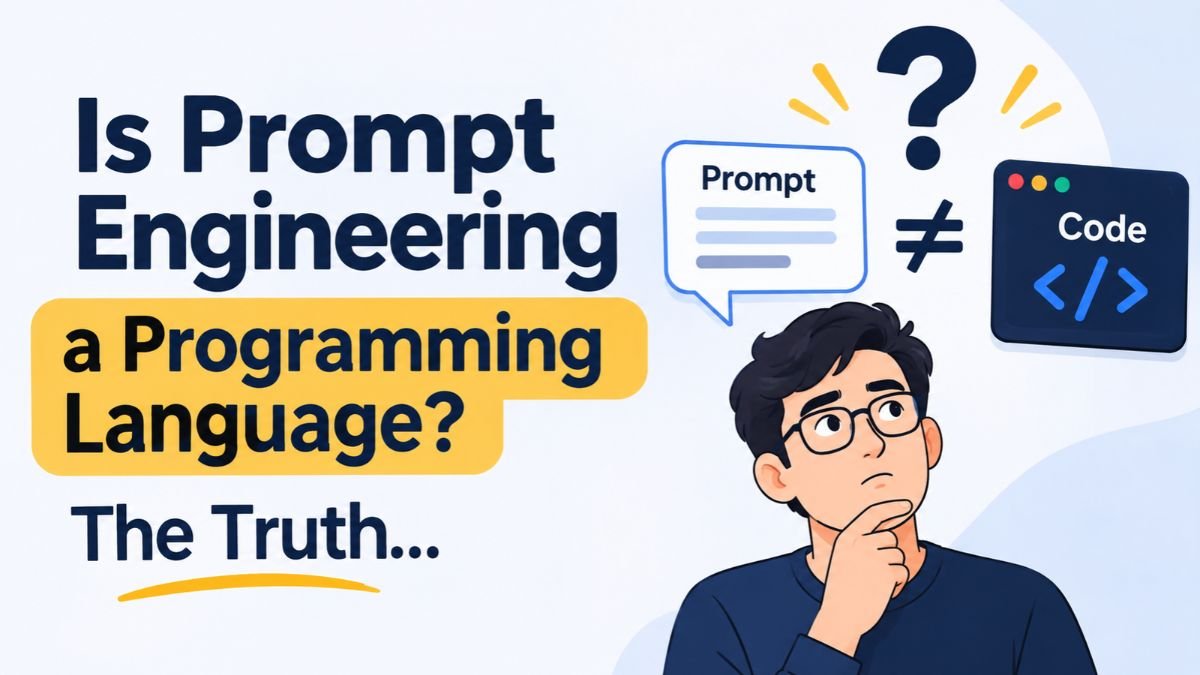


No, prompt engineering is not a programming language in the formal sense. However, natural language has become a powerful new interface for building software, allowing people to describe what they want and have AI translate those instructions into code. It adds another abstraction layer to programming rather than making traditional code obsolete.
What counts as a programming language?
A programming language is a structured way of giving instructions to a computer. It has defined syntax (rules for writing valid instructions) and semantics (what those instructions mean and how they behave). Languages such as Python, Java, and C allow developers to express operations that computers can execute through an interpreter or compiler.
Unlike ordinary conversation, programming languages are designed to minimize ambiguity. When a program receives the same input under the same conditions, its behavior is generally predictable, assuming it has no randomness or external changes.
For example, this Python code always adds two numbers:
def add(a, b):
    return a + b

print(add(5, 3))
The output will always be 8. The computer does not need to guess what the developer meant, interpret the tone, or make a creative decision.
Programming languages also support debugging, testing, error handling, and structured logic. Developers can inspect how an application behaves, find problems, and correct specific instructions.
That predictability is one of the biggest differences between programming languages and natural language. Code is written to be interpreted according to defined rules, while human language relies heavily on context and interpretation.
What is prompt engineering, really?
Prompt engineering is the practice of writing instructions, providing relevant context, and defining constraints to guide a large language model (LLM) toward a useful response.
An LLM is an AI model trained to process and generate language. At a basic level, it generates text by predicting likely next tokens (small units of text) based on the preceding context. This makes it capable of writing code, explaining concepts, generating content, and solving certain problems using natural-language instructions.
A prompt can be as simple as asking an AI to create a calculator or as detailed as specifying its features, layout, input validation, and expected behavior.
However, prompts do not work like traditional source code. AI models generate probabilistic outputs, meaning their responses are influenced by learned patterns and probabilities rather than a fixed set of instructions executed in the same way every time.
The same prompt may generate different code, explanations, or solutions across separate runs. Even if both outputs look correct, one might contain an edge-case bug or a different implementation.
Prompt engineering is therefore less about writing executable instructions and more about communicating intent clearly to an AI system.
Prompt vs. code: How are they different?
Natural-language prompts and programming languages can both be used to create software, but they operate differently.
| Factor | Programming languages | Natural-language prompts |
|---|---|---|
| Syntax rules | Strict, defined grammar | Flexible, no universal structure |
| Ambiguity | Usually low when code is valid | Can be high depending on wording |
| Determinism | Predictable under fixed conditions | Outputs can vary between runs |
| Debuggability | Errors can be traced to code and logic | Prompt changes may not fix underlying code errors |
| Testability | Supports repeatable automated tests | Prompts can be tested, but outputs may vary |
| Version control and reproducibility | Code changes can be tracked precisely | Prompt history helps, but model changes and context can affect outputs |
| Portability | Code can work across compatible environments | Prompt behavior may differ across models and tools |
| Speed to first draft | Requires writing the implementation | Often much faster to get an initial result |
Prompts win on accessibility and speed. A beginner can describe a basic application without knowing every syntax rule, while an experienced developer can use AI to generate boilerplate (repetitive code that provides a starting structure).
Code wins on precision, reliability, control, and repeatability. A prompt may help create a program quickly, but the resulting program still needs to meet specific requirements and behave correctly.
The two are useful together. Natural language helps define what to build, while code determines how the computer actually executes it.
Why do people say “English is the new programming language”?
The idea that natural language is becoming a programming interface has been popularized by computer scientists and AI researchers, including Andrej Karpathy. The underlying argument is that people can increasingly communicate their intentions in ordinary language instead of manually writing every instruction in a traditional programming language.
This is a meaningful shift. In the past, building even a simple application required knowing how to write its logic, handle inputs, and structure its components. Now, a person can describe the desired outcome, and an AI model can generate an initial implementation.
This approach is often associated with vibe coding, a term for building software by describing what you want to AI, iterating on the output, and relying heavily on AI-generated code rather than manually writing every line.
For example, someone could ask AI to build a student attendance dashboard with a search bar, attendance percentages, and a way to flag students below a threshold. They could refine it by asking for a different layout or additional features.
This lowers the barrier to entry. People who lack formal programming experience can experiment with software creation, and developers can spend less time on repetitive work.
But being able to describe software in English does not mean the language itself has acquired the properties of a programming language.
Why is prompt engineering still not a programming language? Four reasons
1. Natural language is ambiguous
A prompt can have multiple interpretations. Even a seemingly simple request may leave important details undefined.
For example, asking AI to “create a function that calculates a student’s attendance percentage” does not specify how cancelled classes, missing records, or students with zero scheduled classes should be handled.
AI might generate a function that divides attended classes by total classes, but it could mishandle a zero denominator or count cancelled classes incorrectly. The output may look reasonable while producing incorrect results.
Programming requires clear definitions of expected behavior. A prompt cannot guarantee that every possible interpretation has been resolved.
2. AI output is not deterministic
LLMs do not always produce identical responses to the same instructions. Their outputs can vary due to sampling, settings, model changes, or differences in context.
This means a prompt that generates working code today may produce a slightly different implementation tomorrow. The new version could introduce a bug, remove a feature, or interpret an instruction differently.
Developers cannot treat generated output as automatically correct just because it looks convincing.
3. The generated code still needs review
AI can generate functional code, but it can also introduce security vulnerabilities, inefficient logic, incorrect assumptions, or dependencies that are not appropriate for the project.
For example, an AI-generated login system might appear to work but store passwords insecurely or fail to restrict access to certain pages.
The responsibility for checking the output still rests with whoever deploys or maintains the software. Reviewing, testing, and securing the generated code remain essential.
4. When software breaks, you still debug the code
A prompt describes what you want, but the actual failure usually occurs in the implementation.
If a dashboard shows incorrect attendance percentages, the problem could be a faulty calculation, an incorrect database query, or a bug in how missing values are handled. Rewriting the original prompt repeatedly may not reveal the root cause.
Developers need to inspect the code, trace the data, reproduce the error, and fix the underlying logic. AI can assist with that process, but understanding the code remains valuable.
[ADD FIRST-HAND EXPERIENCE: a short 3-4 sentence section where I ran the same prompt 3 times and compared outputs]
A better mental model: Programming abstraction layers
Programming has continuously evolved to make it easier for humans to communicate instructions to computers.
- Machine code: Binary instructions executed directly by the processor.
- Assembly: Human-readable representations of low-level instructions.
- C: A higher-level language that makes memory and system operations easier to express.
- Python: A more accessible language with simpler syntax and built-in abstractions for common tasks.
- Natural language + AI: Describe a goal in ordinary language, and AI helps translate it into code, logic, or other executable components.
<PRIVATE_PERSON>Each new layer reduced the amount of low-level detail developers needed to handle directly. However, it did not completely remove the need for the layers beneath it.
Python did not eliminate C. C did not eliminate assembly. Higher-level languages made development more convenient while leaving lower-level technologies relevant for performance, control, and specialized work.
Natural-language programming follows a similar pattern. Prompts are becoming a new abstraction layer on top of existing programming technologies. AI can handle more of the translation, but the underlying code, frameworks, operating systems, and hardware still perform the actual work.
This is why calling prompt engineering a new programming language misses the bigger picture. It is a new way of interacting with the programming stack.
What actually matters now: From prompts to specs and context
As AI-assisted development becomes more practical, writing a clever one-line prompt is not the only skill that matters. Developers need to provide AI with the right information to produce useful results.
This is where specifications and context engineering come in. A specification describes what software must do, including its requirements, constraints, and expected behavior. Context engineering focuses on providing the AI with the relevant information it needs, such as project structure, existing code, documentation, rules, and examples.
Instead of asking, “Build me an attendance app,” a better instruction explains who will use it, what data it handles, how attendance is calculated, what happens when data is missing, and what the finished application should support.
Clear requirements reduce misunderstandings. Tests help verify whether the implementation meets those requirements. Together, they create a more reliable workflow than repeatedly changing prompts and hoping for the right result.
What should you learn?
If you are a student, beginner, or working developer, do not abandon programming fundamentals because AI can generate code.
Learn how variables, functions, loops, data structures, databases, APIs, and error handling work. You do not need to memorize every syntax rule, but you should be able to understand the logic behind a program and recognize when something is wrong.
Also learn how to write clear specifications, create test cases, and review AI-generated code. These skills help you turn an idea into a working application rather than just a promising prototype.
Prompting should be part of your toolkit, not a substitute for technical understanding. The more you understand software, the better you can direct AI, evaluate its output, and fix problems that it cannot solve reliably.
For beginners, Python remains a practical starting point. Learning one programming language properly will make it easier to work with AI-generated code in almost any technology stack.
Conclusion
Prompt engineering is not a programming language, but it is changing how people interact with software development. Natural language now sits above traditional code as a powerful interface for describing intent and generating implementations. That makes programming more accessible without removing the need for technical understanding.
Learn to communicate requirements clearly, use AI effectively, and understand the code it produces. That combination is far more valuable than relying on prompts alone.
Frequently Asked Questions
Is prompt engineering a programming language?
No. Prompt engineering involves writing instructions and context for AI models, not defining executable instructions through a formal programming grammar. AI can translate prompts into code, but the prompt itself is not executed like Python or Java. It guides the model’s probabilistic generation process.
Will AI replace programming languages?
AI is unlikely to make programming languages obsolete. It may change how developers write and interact with them, automating repetitive coding and translating natural-language requirements into implementations. Programming languages will remain necessary for execution, control, performance, and maintaining software systems.
Do I still need to learn coding in 2026?
Yes. AI can generate code, but understanding coding helps you verify correctness, debug issues, evaluate security, and maintain applications. You may not need to write every line manually, but knowing how software works gives you greater control over what AI builds and helps you avoid depending blindly on generated results.
Is prompt engineering a real career?
Prompt engineering is a real skill used in AI-related work, but a career focused only on writing prompts may be less durable as AI systems and interfaces evolve. Skills such as software development, domain expertise, evaluation, automation, and workflow design provide a stronger foundation for roles involving AI.
What is the difference between prompt engineering and programming?
Programming involves creating structured instructions that a computer can execute through defined rules. Prompt engineering involves communicating instructions, constraints, and context to an AI model so it can generate a response or perform a task. Programming provides precise control, while prompting offers a flexible way to express intent.


We believe that everyone has the potential to learn to code, and we are committed to making that happen. Our courses are designed to be engaging and interactive, and we offer a variety of learning paths to meet the needs of all learners.
We are also committed to providing our learners with the support they need to succeed, and we offer a variety of resources to help learners learn at their own pace.
If you are interested in learning to code, we encourage you to check out our courses. We are confident that you will find our content to be high-quality, valuable, and makes sense.
- GenAI / LLM Interview Questions for Experienced Developers (3 and 5 Years Experience) - November 24, 2026
- Is Prompt Engineering (Natural Language) the New Programming Language? - November 24, 2026
- What is Python? A Beginner-Friendly Introduction with Real-World Examples - July 4, 2026